South Korea

South Korea

Monday, July 18, 2016

The Road from Jeonju back to Seoul

July 15th 2016

This morning began with a lovely walk around a gigantic lake filled with thousands upon thousands of blooming lotus flowers. Our host pastor even treated us to a duck boat ride on the lake.


We said farewell to Rev. Lee and his family. Then we took a bus to Cheongju. where we met with Rev. Kun Hee Lee the pastor of one of the most historic churches in the PROK. In his office we had a lengthy conversation on theological education, ministerial assessment, and pastoral misconduct policies. Afterwards he showed us around the church campus. The building is located on a site were several Catholics were martyred. The church is known for its integral involvement in the democracy movement within Korea and there were numerous markers celebrating the church's impact on society. One of the former pastors was even elected to be be the vice president of the country. The church has bullet holes along one side of the building from gun fire during the Korean war.


After this visit we traveled about 30 minutes by car to Dukchon Church. This is a very rural church who have an exemplary ministry. Many years ago the church started a credit union for the community, which is mostly farmers. The credit union now has over 1.2 million U.S. dollars in its holding which are used to support local farmers and community projects. The congregation did agricultural training for years, building trust and support in the community. When the church began to look at the agricultural market they realized that their traditional crops would not be sustainable in the long run, so the congregation encouraged local farmers to switch to raising a particular type of pumpkin. The community now produces 80% of this product within the country, thus determining the market rate. Farmers in this village earn twice the wage of farmers in other parts of Korea. The church also supported a livestock cooperative, a coffee shop, day care center and other rural advocacy training programs. Additionally, the congregation noticed that there were many migrant laborers from Thailand in the area so they hired a minister from Thailand to serve the community. Seeing this congregation's work makes me glad that the new UCC Local Church Profile asks the question "Who is our neighbor" my prayer is that congregations will take that question seriously and provide services such as this church is doing to make a difference in the lives of the community where the congregation is located.


After a lovely dinner with the pastor we took a bullet train back to Seoul.

Jeonju: Day Two

July 14th 2016

Today started out with examples of hybrid religions:

  • We visited a Presbyterian Church built in 1909 in the shape of an L so that male and female worshipers could not see each other which was part of Confucius practices. 
  • Then we went to a temple that I would best describe as unitarian, supporting teachings from multiple religions. 


Then we visited Go Baek PROK church. This church was founded 50 years ago, modeled on Bonhoeffer's confessing church. They were founded with three main goals 1. to confess the trinity, 2. to support their community and 3. to work for Korean reunification. (I personally have deep appreciation for the clarity of purpose described by many PROK congregations). The Go Baek Church is pastored by a husband and wife team. We had met the male pastor earlier in the week at the PROK reunification committee meeting, today we were hosted by the female pastor, Rev. Kangsil Lee.

She told us a story about her husband's work for reunification. The congregation had been praying for movement on reunification by August 15th 2000. On June 15th 2000 the presidents of north and south Korea met for the first time. This date, June 15th, became an important day to celebrate the work of reunification. By the year 2010 South Korea had a much more conservative president who banned all unofficial travel to the north. The pastor felt it was important to continue to build church relationships (remember these have to be in person because phone or email communications are limited to the north). He decided to cross into the north to celebrate the 10th anniversary of the June 15th 2000 meeting of Korean leadership. He spent 70 days meeting with church members, laborers  and teachers. He then walked back through the Demilitarized Zone and was promptly arrested by the south for not receiving government permission to travel. He remained in jail for three years. Released in 2013 he continues to work for reunification.


Rev. Kangsil (who had spent time at Andover Newton Theological Seminary) spoke about some of her research in New Zealand on reconciliation and believes that there is possibility for a formal reconciliation process to take place between the north and south using principals of restorative justice.

She took us to have tea with a very well known monk. He was the person who invented "Temple Stays" a very popular way for tourists and curious individuals to spend a few days living in a temple and experiencing the routines of a monk. We had a very robust conversation with the monk, Rev. Kangail Lee and our host pastor Rev. Soon Tae Lee about U.S. hegemony in the region. They asked for our prayers for Korean reunification and we asked their prayers for gun violence and racial tensions in the United States
.

We discussed Buddhist philosophies of the lotus flower as emerging from the mud to be something clean and beautiful and of impermanence; meaning that everything is constantly changing.


After the temple we went to a Senior Center (Rev. Soon Tae Lee is the chair of the board). Visiting senior centers has been an important part of our trip because this is an emerging ministry for the church. Historically there were deep roots in children caring for their parents, however, now with the increased migration to cities for jobs families are not all geographically located close together and the family system of support is eroding, opening up clear ministry needs for seniors.  This particular center offers 200 free lunches a day to seniors, provides counseling, continuing education, group activities, job training and preventative health care. A partnership between the UCC's Council on Health and Human Service Ministries (CHHSM), Retirement Housing Foundation (RHF) or United Church Homes with the PROK programs serving the elderly could be very fruitful.


Our dinner program was filled with both sadness and hope. There was a PROK pastor serving as a missionary in China. He was doing excellent work both with the Chinese community as well as North Korean Refugees in China. Tragically he was killed in a traffic accident. His fellow pastors have started a foundation in his honor in order to continue this vital work. We listened to their compelling
stories. They would very much like to find a conference within the United Church of Christ or Disciples of Christ with whom to partner in order to strengthen this ministry.


Sermon: Down from the Mountain

Sermon: Down from the Mountain 
Rev. Holly MillerShank
July 2016, Korea

Text: Matthew 17:1-13 NIV
After six days Jesus took with him Peter, James and John the brother of James, and led them up a high mountain by themselves. There he was transfigured before them. His face shone like the sun, and his clothes became as white as the light. Just then there appeared before them Moses and Elijah, talking with Jesus. Peter said to Jesus, “Lord, it is good for us to be here. If you wish, I will put up three shelters- one for you, one for Moses and one for Elijah.” While he was still speaking, a bright cloud enveloped them, and a voice from the cloud said “this is my Son, whom I love; with him I am well pleased. Listen to him!” When the disciples heard this, they fell face-down to the ground, terrified. But Jesus came and touched them, “Get up,” he said. “Don’t be afraid.” When they looked up, they saw no one except Jesus. As they coming down the mountain, Jesus instructed them, “Don’t tell anyone what you have seen, until the Son of Man has been raised from the dead.” Then disciples asked him, “Why then do the teachers of the law say that Elijah must come first?” Jesus replied, “To be sure, Elijah comes and will restore all things. But I tell you, Elijah has already come, and they did not recognize him, but have done to him everything they wished. In the same way the Son of Man is going to suffer at their hands.” Then the disciples understood that he was talking to them about John the Baptist.

I am extremely grateful for the opportunity to worship with you today. I am especially thankful for the partnership between the PROK and Global Ministries and that our partnership can be made manifest in common worship services such as this.
I recognize that the text I selected for today is generally read on Transfiguration Sunday; the Sunday before Lent begins. Transfiguration Sunday is a liturgical reminder of Jesus’ divinity and calls the listener’s attention to the fact that this isn’t just any man going through the trials of the Lenten season but that it is indeed the Son of God. I believe that this is a rich text that teaches us many lessons throughout the year and not just at the inauguration of the Lenten season.

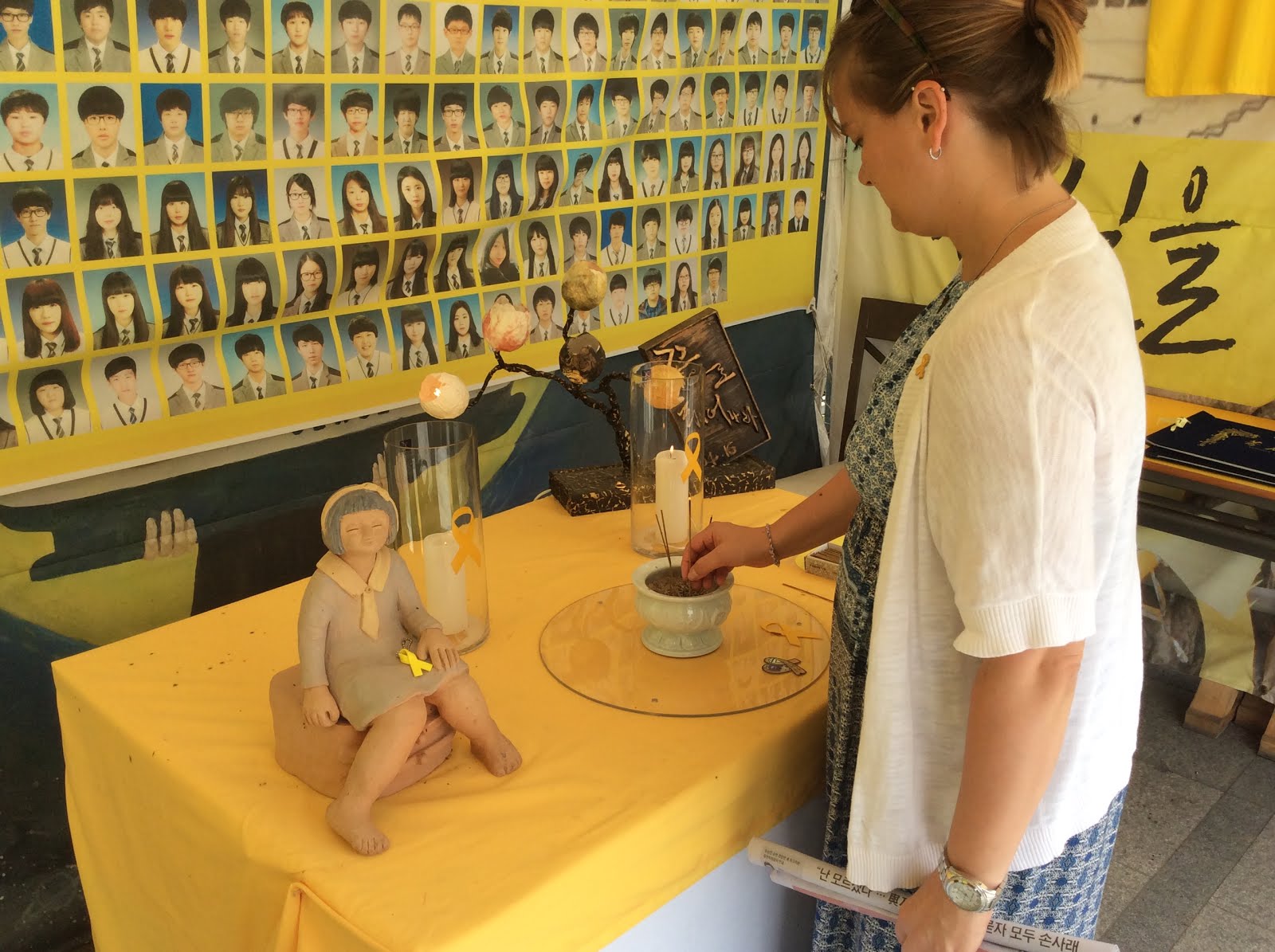
Regarding this text, first, I want to talk about the desire to mark sacred spaces as holy. During this six week journey that Jonathan and I have had with the PROK getting to know Korean history and to experience contemporary Korean culture we have visited many sites that have been marked for important memorial occasions. We visited the site in Jeam-Ri where the men who spoke out against Japanese rule during the March 1st 1919 uprising were forced into a church and burned alive. We also visited the April 19th memorial marking the graves of the students and professors who spoke up against corrupt presidential leadership in 1960. We have been to Ansan and Jindo where memorial sites have been set up in remembrance of the lives of hundreds of youth killed in their prime in the Sewol Ferry tragedy.

Sights such as these are an integral part of the human condition. We know that our ancestors; from Moses to David to Jacob used stones to mark important sites. Rocks where placed upon rocks and prayers uttered; claiming the ground as sacred and asserting that the actions that took place on at these locations would be remembered for generations to come. The sites that we have visited so far in Korea have been powerful reminders of the past as well as commitments towards a different future.
You see that’s the thing about memorializing a site, a memorial can never adequately capture the pain or joy of a specific moment, nor can a memorial ever exist in isolation from the future. In our scripture from today Peter wants to create booths for Moses, Elijah and Jesus. Peter want to hold this sacred moment, he wants to capture it and somehow to contain it. But God cannot be contained by any memorial. As if to prove a point, God speaks at the exact moment when Peter is proposing building the shelters and says that “this is my son with whom, I am well pleased”. God seems to be telling Peter that it is not a physical location that is to be memorialized but that is a person, specifically Jesus, whose life is to be modeled as the most powerful witness to God’s love.

Jonathan and I have taken in a great deal of information about Korean history, and while we are striving to learn the dates and names of exact moments in time, it is obvious that is the collective spirit of dignity, accountability and self-determination that are the overall hallmarks of the people which are collectively more powerful than any one monument or memorial.

A shift occurs in our text as soon as God’s word is spoken. No longer is the desire to remain on the mountaintop, but instead the direction of Jesus and his followers shifts down the mountain. As often seen in Biblical narratives, the mountaintop is sacred encounter with the Holy experienced by a select few; recall Moses going up the mountain to receive the commandments or when he summits mount Abarim to witness the promise land that he will not live to experience himself; in all of these mountaintop experiences the protagonist travels back down to carry God’s message to the people. The transfiguration narrative is no different; God’s word is experienced in one place but does not remain sequestered there, it travels back down the mountain to be with God’s people.

During this trip we have worked with numerous PROK churches and have found that the commitment to sharing God with the community is an essential aspect of the ministry of your denomination’s churches. We have found congregations that bake bread for the hungry, congregations that farm the fields to feed factory workers who have lost their jobs, we have sat in the senior citizen day center of a PROK church that ministers to the needs of those who have suffered strokes and cannot remain on their own during the day. We’ve had coffee in community shops run by churches as safe meeting spaces for the community, we’ve seen daycare centers run for the children of migrant workers and meeting halls where public forums are held and protests planned.
These are all examples of bringing the word of God down from the mountaintop experience of Sunday morning worship and into the everyday aspects of humanity.

In the United Church of Christ, where I am an ordained minister, we believe in three core value; first that God is still speaking; meaning that God continues to reveal a meaning and purpose for God’s people in this current age. Secondly, we believe in Jesus’ extravagant welcome, meaning that no matter who you are or where you are on life’s journey that you are welcoming into the faith and family of Jesus Christ. And finally, we believe that the role of the Church is to change lives; meaning that our faith cannot remain solely in our heads or our hearts but must be lived out in direct actions that change the lives of the communities where are churches are located. It is our responsibility to live into our request that we recite in the Lord’s Prayer asking to have God’s will be made manifest on earth as it is in heaven.

We have been witness to congregations throughout the PROK striving to make God’s promises of justice and peace a reality not only within the membership of those who belong to the church but even more so within the communities where the congregations are located.

We have heard much about the PROK’s work for reunification and applaud the consistent message of reconciliation. Jonathan and I will both freely admit that the conversations we have had here on reunification of the Korean peninsula is not the same one shared with us through the media in the United States. This is part of the reason why partnerships are so important. You see, when Jesus went up the mountain, and experienced the transfiguration he did not do so alone. He took his disciples with him, and not just one of them but several of them.

The disciples are examples of partnership, no one disciple has the right answer to fully explain what they were experiencing on the mountaintop or how to respond to the experience, but they were able to talk and share together. Together they were able to move towards greater discernment and understanding of Jesus’ teachings including the understanding that John the Baptist had been the prophet Elijah sent again to call the earth to repentance.

The difficult work of following Jesus should never be attempted alone; doing so can only lead to myopic understandings of the Gospel. Just think why it is that we have four different interpretations of the Gospel included in the Bible. We always need different perspectives in order to grow in our understandings of Christ’s teachings. The same thing is true for our ecumenical partnerships, by working collaboratively towards a more complete understanding of God’s call we strengthen the witness of Jesus Christ across the globe and simultaneously improve our own faithful witness within our individual denominations.

Being with the Presbyterian Church in the Republic of Korea has been a transformative experience for both Jonathan and me. Our own faith has been strengthened; we have visited powerful monuments of historical events and lamented with all of Korea in the loss of young lives in the Sewol Ferry. We have had just a small taste of what it is like in Korea to come down from the mountain and share God’s word among the community, and we have been witness to the power of partnership. We pray that our time here has been equally beneficial to those who have given generously of their time to meet with us.

Finally, I would be remiss if I did not mention the vital aspect of women’s dignity we have encountered on our trip so far. I realize that there are no women listed as eyewitnesses to the transfiguration in today’s scripture lesson but we do know that it was women who were the first witnesses to Christ’s resurrection. The role of women in society is an imperative part of the biblical narrative. Women’s lives are essential to the perpetuation of the gospel. It is crucial that all governments and churches take the role of women in society seriously and create mechanisms for equality as well as reparations for the systemic mistreatment of women in the past. During this trip we have talked with women lured into the sex industry near military bases and with women’s whose bodies were used as battle grounds during the Japanese occupation. These incidents are not isolated to Asia but are replicated across the globe. Violence against women is a worldwide epidemic and is why the world council of churches has repeatedly fostered programs to address violence against women.

While there is much to celebrate about our shared ministry and our ever-growing partnership, it does not mean that there is not more work to do. Jesus comes down from the transfiguration to face some of the most difficult days of his ministry. It is after the transfiguration that he calls out the unjust acts of the Roman Empire and of the religious elite. It is after the transfiguration that he turns over the tables of the money changers and is anointed by the unnamed woman with expensive perfume for his impending death. No, my friends, the work of ministry is not done. We cannot be like Peter wishing to build booths hoping to remain unchanged, instead we must journey forward with Christ and with one another striving always to bear the most faithful witness possible to the creating God’s kingdom here on earth. I welcome being a traveling companion with you on this journey and pray that our two churches will be partners along the way.


May it be so. Amen. 

Jeonju: day one

July 13th 2016

Yesterday we arrived in Jeonju, a midsized city in the middle of the country. The city is the birth place of the first king of the Joseon Dynasty and has a lovely melding of ancient and modern. Our host was PROK pastor Rev. Soon Tae Lee and he worked diligently to give us the best overview of the region possible. Here are some highlights of our trip:

1. Jesus Hospital: this hospital was started in 1896 by a woman doctor from the United States connected to the Presbyterian Church. We toured the hospital's history museum with the chaplain (he is one of the few full time ministers in a specialized setting that we've met on this trip). The hospital has had several directors from the United States throughout its history, each bringing a particular medical expertise and focus to the institution. We also visited the missionaries grave-sites, a small chapel, and the location of the original hospital.


2. Royal grounds: we toured the historic grounds of the king during the Joseon dynasty. Interesting features included historic archives of the time period which were preserved for generations, including safe keeping through several wars. There were also ancient portraits on display of the various kings during this time period. A delightful visual were numerous school groups dressed in traditional Korean clothing roaming the grounds.


3. A Catholic Church: built in 1914 this church is one of the bedrock locations for Catholicism in the country. There were several catholic martyrs from this region.


4. Bibimbap: this is a traditional Korean meal which literally means mixed rice. Jeonju is famous for it, the meal comes with countless fresh vegetables and spices beautifully arranged in the bowl over rice which you then stir together and enjoy.


5. Sewol Ferry Memorial: most cities continue to have public memorials to the Sewol Ferry tragedy both to publicly remember the victims and to continue to call for government accountability.


5.5 City Gate: too much to remember! We also stopped at the primary city gate to Jeonju.


6. Peasant Uprising Memorial: we toured a museum dedicated to the peasant uprisings which stared in the region in the late 1890's. These uprisings began against the aristocracy of the Joseon dynasty but quickly shifted to resistance of the Japanese invasion in 1909. These activists played a key role in the March 19th Independence Movement.


7. Ice Cream: seriously, it's hot out, some where in the 90's and very humid, we needed ice cream.


8. Hike and nap: we walked far above the city to one of the most famous public pavilions in the region. The first king of the Joseon period build this pavilion as a place to celebrate victory on his return home from defeating Japanese pirates. The hike was quite strenuous and all of us dozed a little once we reached the shade of the pavilion.


9. Confucian School: We visited the site of a historic Confucian school where boys were taught the Confucius world view. (https://en.wikipedia.org/wiki/Confucianism). Jonathan was particularly intrigued by a 400 year old tree.


10. National Intangible Heritage Center: this is a museum dedicated to Korean traditions including bamboo weaving, metal working, instrument making, textiles, dance, song, and other crafts. We toured the permanent exhibits as well as the special exhibit on flowers.


11. Senior Restaurant: We stopped for a cold drink at a restaurant that provides jobs for senior citizens. Many seniors in Korea are forced to retire because of the incredibly competitive workforce, but are then faced with too little pension to live on. The pastor showing us around is the chair of the board for this restaurant which employs eleven seniors.


12: PROK church tour: the pastor took us for a tour of his congregation, he is not only the pastor of the church, and the chair of the senior support restaurant, he is also the chair of the interfaith human rights committee for Jeonju, he teaches Old Testament in the local university, and is a trained psychotherapist. (The only way Jonathan and I can figure out how PROK pastors can do so much is because of the incredible lay leadership of the congregations, the congregations are very supportive, in face expect, their pastors to be engaged in the community just as the church members are also engaged in the community).

13. Dinner: We met one of the church elders for a lovely Korean dinner (another elder treated us to dinner the evening before) both men have been elders in the congregation for over 50 years. The one from the first evening was the head of social work at the Jesus Hospital and the one this evening was a high school science teacher.

14. Quick! Change for church!

15. Wednesday Worship: I preached for Wednesday nigh worship. The pastor's son did the translation for me. He is currently doing his compulsory military service but requested leave for a few days to help translate for us. I preached on Matthew 17:1-3. I'll include the manuscript in a new blog post.


This was day one in Jeonju. It is a great town and one I would highly recommend exploring, perhaps at a bit more leisurely pace than us!

God, please bless those who are weary. Amen. 


THAAD and Reunification

July 12th 2016

Today we started the day meeting members of the National Council of Churches, Korea staff. The staff is preparing to leave for the United States next week to take a cross country trip collecting signatures supporting the reunification of the Korean peninsula, ending in Washington DC where the petitions will be delivered to the White House. Your prayers and support are encouraged, more information can be found at: www.globalministries.org/seeking_peace_with_justice_in_korea

Next we met with the Reunification Committee of the PROK. They were very thankful for the supportive work that the United Church of Christ and the Christian Church (Disciples of Christ) have done, especially the 2015 General Synod and General Assembly resolutions supporting the reunification of the Korean peninsula.

Korea has been in the U.S. news lately because of the announcement between South Korea and the United States to implement the THAAD missile defense system.

https://en.wikipedia.org/wiki/Terminal_High_Altitude_Area_Defense

It was clear that the members of the reunification committee felt that THAAD's development benefits the United States much more than it does South Korea. There was much discussion on the actual capabilities of THAAD and the overall sentiment is that the defense system gives the United States a stronger foothold in Asia from which to engage China and Russia. The committee was also very concerned with the financial burden being passed on to South Korea for the implementation of a weapons system that would significantly benefit the United States. There was complete agreement that the preference of the committee would be to support further negotiations between the north and south rather than continue to escalate the weaponization of the situation. They asked that we carry this message back to congregations and legislators in the United States.

Our conversations with the committee was enlightening to think about the geo-political realities of the Korean peninsula. One of the committee members called THAAD an attribute of the "neo-cold war". The reason Korea is currently divided is because in 1945 after WWII ended and Japan was forced to leave Korea, world powers could not decide who would maintain control of the region. U.S.S.R. was granted the northern part of the country and the United States the southern region. The Korean war erupted in 1950 when the north, as backed by the Soviet Union and later China attacked the south, where the United States and other allied forces which were part of the United Nations responded to the aggression. (Several people in the south have approached us to express their appreciation for the support of the United States during the Korean War).

Technically, the war in Korea has never ended, only the cease fire (armistice) agreement signed by the United States (on behalf of the U.N.) China, and North Korea exists. The armistice agreement penned in 1953 said that within three months the signers would return to the negotiation table to develop a peace treaty. Since that time period the Korean peninsula has remained a country divided and used as part of a larger global conflict centering on controlling east Asia and the Pacific. Control and influence in the Korean peninsula remains a priority for Russia, China and the United States, leaving the true sovereignty of Korea in question, as it has been since the end of the Joseon Dynasty in 1909.

August 15th is the anniversary of Korea's liberation from Japanese occupation (1909-1945). The reunification committee encouraged congregations in the UCC and DOC to join with them on that date (or the Sunday closest to that date) to pray for a peaceful reunification of the peninsula. Prayers and additional information can be found in the Global Ministries link above.


In our conversations after the meeting Jonathan and I agreed that the history courses we were taught in the United States as well as the messages provided through U.S. media provide a much different perspective on the region than the information we are receiving throughout this trip. 

Creator God, when you called forth light and life and separated the land from the seas, you did not draw boarders between nations and you did not create weapons of war. May we honor creation and one another by seeking to find unity that celebrates the diversity of all that you have created and called good. Amen.  

Commitment to being a global citizen

July 11th 2016

Throughout our time in Seoul we have been living in a classroom on the 3rd floor of the Children's Village which is part of Global Sarang. The accommodations are lovely; Jonathan and I have a room and we share a bathroom and kitchenette with Dr. Kahala Cannon, a Global Ministries Missionary working in Korea. Kahala is a dentist from Tennessee who has been working for the past two years in India. For the past three months she's been teaching English two days a week for the school of Global Sarang and two days a week for the Wildflower Youth center we visited during our first week in Korea.

Today we spend the day getting to know the ministries of Global Sarang in greater detail. We started out in Rev. Kim's office, he is the founder and director of Global Sarang. Many years ago he began working in factories raising concerns for the working conditions for Koreans. He quickly realized that the most vulnerable in the workforce were migrant workers who had no legal rights within the country.

Currently the umbrella of Global Sarang includes a migrant labor center, a hospital, several schools, day care centers, and a woman's shelter. In addition to his responsibilities with coordinating the work of Global Sarang, Rev. Kim is also a pastor of a local PROK congregation. Through his leadership there are several worship services conducted for migrants from Sri Lanka, Nepal and China. The church also has a missionary training program.


Our day consisted of visits to several locations:

1. Rev. Kim's office and the administration center for Global Sarang. This building also houses an after school program.

2. One of the main Global Sarang building which has a cafeteria where free meals (lunch and dinner) are provided for all migrants, roughly 200 a day. The building also had a shelter and a hospital which includes services for dentistry, outpatient and inpatient services (currently the facility is in need of qualified doctors).

3. The main building for migrant workers which included an entire row of translators (at least a dozen) there to help translate labor concerns for workers, there was also a counseling center (labor rights, work related injuries, visas etc) and classrooms for teaching Korean, computer skills, and tae kwon do. There was also a large auditorium in the building that migrants could use for free to celebrate their own local holidays. The labor center counsels approximately 40,000 workers per year.


4. We visited the school were Dr. Cannon teaches two days a week. The school has kindergarten through high school. We had lunch with the kids and visited the various classrooms. All of the students are from migrant families and their education is provided for free. Later in the week an orchestra comprised of entirely blind members were coming to perform at the school.


5. Next we traveled to a kindergarten program that is considered a public school but the government contracted with Global Sarang to run the administration. We arrived at nap time so we were just able to visit with one class of children because the others were resting. The center stays open from 7:30am to 7:30pm to help working parents.


Global Sarang, and specifically Rev. Kim have been instrumental in raising the profile of migrant workers in Korea. Because of their work Korean labor laws have been extended to all industries in the country (with the exceptions of farming, fishing, and factories with under 5 employees). Rev. Kim has also been a driving factor in the work visa program in the country. Rev. Kim is regularly featured in Korea's equivalent of Time Magazine's most influential people.

The president of Sri Lanka was so impressed with how much Rev. Kim has helped the Sri Lankan community in Korea that he offered him an elephant, which Rev. Kim donated to the South Korean zoo.


We ended the day by attending a weekly prayer service for reunification of the Korean peninsula. The prayer service is held every Monday evening at 7pm in the office building where the National Council of Churches in Korea is located. The service included many Koreans as well as international ecumenical church workers. Together we celebrated communion, prayed for peace and shared together in the unifying spirit of Christ.

Gracious God, with you there are no borders, no division between Jew or Greek, slave or free. We pray that we can live in a world that celebrate the commonality of humanity and treats all people fairly. We give thanks for the work of those who strive to live out Jesus' command to love our neighbor as ourselves and while we no that nothing in this world, not powers or principalities, can separate us from your love, that the borders and boundaries we have created to separate ourselves from one another will come tumbling down. Amen. 

Tuesday, July 12, 2016

What can you do?


This Global Ministries Website has a plethora of resources regarding Korea:

www.globalministries.org/seeking_peace_with_justice_in_korea

On the website you can find advocacy materials for supporting peace in the Korean Peninsula. Signatures for the petition are requested now as a delegation from South Korea prepares to fly to the United States next week to work with U.S. partners to deliver signatures to Congress on July 27th.

The website also has documents from the UCC's General Synod and from the Christian Church (Disciples of Christ)'s General Assembly on the reunification of the Korean Peninsula. There are also prayers, litanies and documents from our partner churches.

We are all sisters and brothers in Christ; education, awareness and advocacy are one of the greatest gifts that we can give to one another.

Reunification_Prayer.jpg